
How Olympian Jake Pates Used WAVi to Support His Comeback

How EEG brain-scan technology supported an Olympic athlete's comeback from injury, and what it means for the rest of us.
And why he thinks every athlete deserves the clarity of a brain baseline
If you watched the snowboard halfpipe in Milan, you may have seen one of the most unlikely comeback stories of these Games: Olympian and WAVi partner Jake Pates. After retiring at age 22 due to multiple head injuries, Pates returned at 27 to snag an eighth-place finish in the Men's Halfpipe Finals.
Over his 15-year career, Jake experienced multiple concussions that affected both his snowboarding and his day-to-day life. But after being introduced to WAVi, he began to see his brain differently, through objective data intertwined with his subjective experience. Having access to WAVi reports helped Jake feel more informed and engaged in conversations with his healthcare providers as they discussed his recovery.
Now, he's bringing that conversation to the world stage.

From baseline scans to the Olympic start gate. Jake Pates with WAVi CEO Dr. David Oakley at Milano Cortina 2026.
Pates is one of the most visible athlete advocates for brain health. He founded the Happy Healthy Brain Foundation to promote objective concussion protocols and baseline brain scans in sports where return-to-play decisions are often rushed.
He has expressed to Forbes his disbelief that measuring the brain isn't already built into routine athlete care. Why aren't scans treated like standard height, weight, and blood-pressure checks during sports physicals?
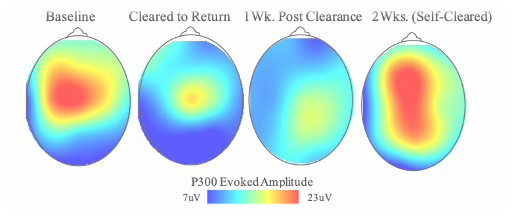
Topographic maps from Jake Pates' baseline, clearance, and post-clearance scans, showing changes in brain reaction voltage over time. Note: these scans were not used to determine medical clearance or return-to-play decisions.
Jake's story highlights a simple but powerful shift: moving from "How do you feel?" to "How is your brain responding?"
Brain activity shouldn't be a guessing game. Objective EEG data provides critical information for clinical decision-making that is often overlooked, and Jake Pates speaking out is a huge win for athletes everywhere.
Thank you, Jake, for helping us champion a world where brain health is treated with the same rigor as a podium finish.
Have Questions About Our Approach?
We're happy to discuss how our Track & Treat methodology can help with your specific condition.
Contact Us